
Born-Accessible Design
Digital technologies, applications, websites, and documents are often created without considering accessibility for people with disabilities. The most common technology development approach is retrofitting, which does not consider accessibility until after release (Wentz et al., 2011). The drawbacks of retrofitting for accessibility include the following: (a) sometimes those technologies never actually become accessible, (b) people with disabilities (PWDs) cannot use the technology until the system or content is retrofitted, and finally, (c) retrofitting accessibility often leads to inelegant, more expensive solutions (Wentz et al., 2011). In addition, retrofitting technology forces an additional, inequitable cost upon the disability community. Olsen et al. (2022) describe an “accessibility tax” as the additional resources that PWDs must expend when software, websites, or other technologies are not accessible, whether to advocate for remediation or to find workarounds when possible (and often they are not possible). (Olsen et al., 2022). Remediating technologies after-the-fact is not a cost-effective approach, and the time delay between when digital technologies and content are built and released and when they are made accessible can itself be a form of societal discrimination.
For years, disability rights groups have demanded born-accessible design, and some government policies and regulations are starting to require it, yet the research literature in human-computer interaction and user experience does not yet define born-accessible design or any methods for it. There can be many potential benefits to using a born-accessible design approach, but nowhere in human–computer interaction research or practice literature is the term or approach for “born-accessible” defined, making it challenging to implement. At this point, born-accessible is more of a call to action from the disability community and accessibility researchers rather than an actual methodology to be incorporated into the digital technology research, design, and development lifecycle.
The only area in which there are definitions and tools for born-accessible design is in the area of book publishing, meaning that one should publish an accessible digital book at the same time that a print version of the book is published. Yet this knowledge on born-accessible concepts from book publishing does not provide guidance on how to design interactive technologies that frequently are modified and updated. People frequently ask whether born-accessible design is the same as the concept of “shifting left,” but it is different. Shifting left refers to incorporating accessibility concepts earlier in development. Yet born-accessible design involves not just accessibility concepts but involving people with disabilities, and disability rights groups, from the start of development, among other concepts.
Starting in 2022, the Maryland Initiative for Digital Accessibility started research on defining and understanding born-accessible design, as well as developing tool concepts to support born-accessible design. This work has been done in collaboration with disability rights groups, technology companies, and government policymakers. This work has been financially supported by the Grand Challenges Program at the University of Maryland, Adobe Research, and the Radcliffe Institute for Advanced Study at Harvard University.
For a background on what it means to do born-accessible design, we suggest one of the following lecture videos:
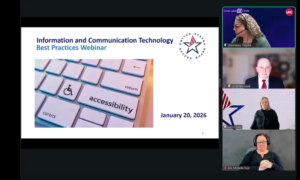 The Born-Accessible Design Approach: Cost-Effective, Inclusive, Compliant, Presentation for the US Access Board, January 2026
We split the work on born-accessible design into three areas: tools, methods, and policies.
Tools
Lazar, J., Kannan, A., Tigwell, G. W., Jain, R., Jawili, MJ, Prasad, Y. S., Siu, A., & Treitman, R. (2025). An Opportunity to Use AI to Support Content Creators in Creating Born-Accessible Documents. In C. El Morr, Y. El-Lahib, & R. da Silveira Gorman (Eds.), Beyond Tech Fixes: Towards an AI Future Where Disability Justice Thrives. Springer: London, 53-66. [Preprint]
Siu, A., Jain, R., Kannan, A., Echevarria, J., Jawili, M. A., Shiva Prasad, Y., Treitman, R., Tigwell, G.W. & Lazar, J. (2026). ColorA11Y: Enhancing Creative Design Workflows with Just-in-Time Color Accessibility Recommendations. In Proceedings of the 28th International ACM SIGACCESS Conference on Computers and Accessibility (ASSETS ’26) (Article 73, pp. 1–21). Association for Computing Machinery.
Methods
Lazar, J., Wood, R., Kannan, A., Feng, J., Tigwell, G., Jawili, MJ, Siu, A., & Jain, R. (2026). Born-Accessible Design: Moving from Theory to Developing a Pragmatic Methodological Framework. Interacting with Computers, 38(5), 1-22. [Preprint]
Lazar, J., Shachmut, K., Drummond, A., Wyant, J., Eng, K., and Rosenblum, H. (2026). A Born-Accessible Approach to Technology Design. ACM Interactions, 33(5), 26-31.
Policies
A number of jurisdictions are either requiring or encouraging born-accessible design concepts. While the term “born-accessible” may not appear in many of these documents, the concepts of born accessible design, the ideas of incorporating people with disabilities and disability rights groups early in development, and not retrofitting, are present. As one government official said: “Born-accessible approaches help with cost cutting. Remediation means rework, and rework is waste. Born-accessible approaches reduce waste.”
Maryland’s state digital accessibility policy which includes the phrase born-accessible design.
White House Memo from 2023 on Strengthening Digital Accessibility and the Management of Section 508 of the Rehabilitation Act which discusses born-accessible concepts on page 6.
ADA Title II Regulations on Nondiscrimination on the Basis of Disability; Accessibility of Web Information and Services of State and Local Government Entities. It includes born-accessible concepts in text such as “The Department believes that it is more efficient and effective for public educational institutions to use the two- or three-year compliance time frame to prepare to make course content accessible proactively, instead of having to scramble to remediate content reactively.”
We want to also highlight that the Association for Computing Machinery called for born-accessible design in their recent tech brief, Advancing Accessibility in the Digital World.
Finally, we also want to highlight two historical articles that provide some of the philosophical underpinnings of born-accessible design:
- Churchill, E. F. (2018). Putting accessibility first. Interactions, 25(5), 24-25.
- Wentz, B., Jaeger, P. T., & Lazar, J. (2011). Retrofitting accessibility: The legal inequality of after-the-fact online access for persons with disabilities in the United States. First Monday.
Project Team
- Adobe: MJ Jawili, Yalpi Shiva Prasad, Rick Treitman
- Adobe Research: Rajiv Jain, Alexa Siu
- Rochester Institute of Technology: Garreth Tigwell
- Shippensburg University: Brian Wentz
- Towson University: Jinjuan Heidi Feng
- University of Maryland: J Bern Jordan, Abhinav Kannan, Jonathan Lazar, Rachel Wood
- US Access Board: Katherine Eng
- US General Services Administration: Andrew Nielsen